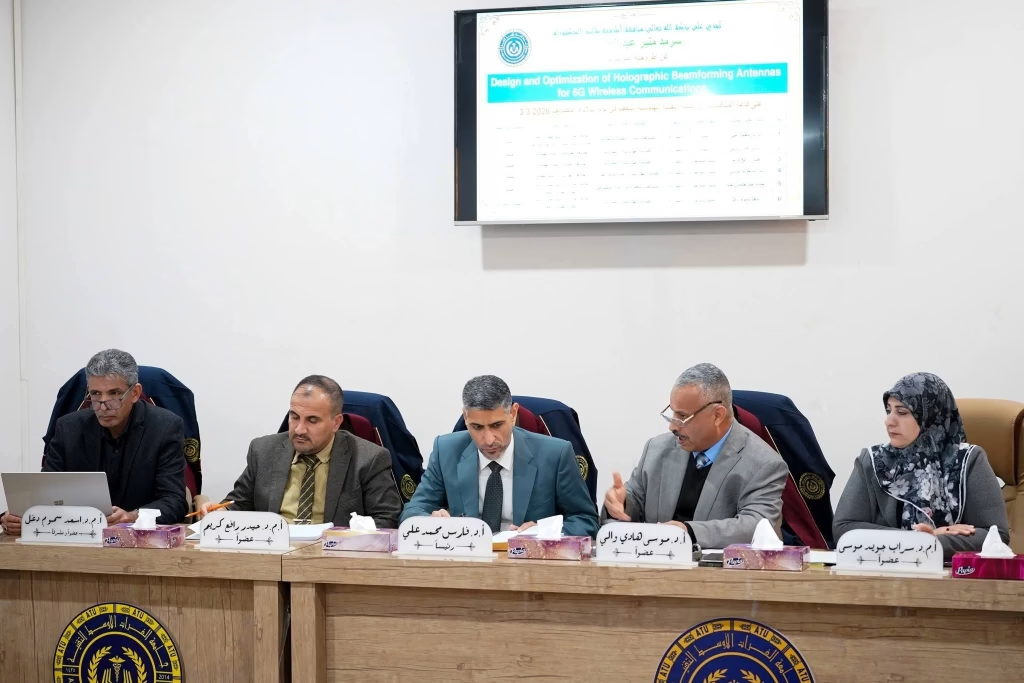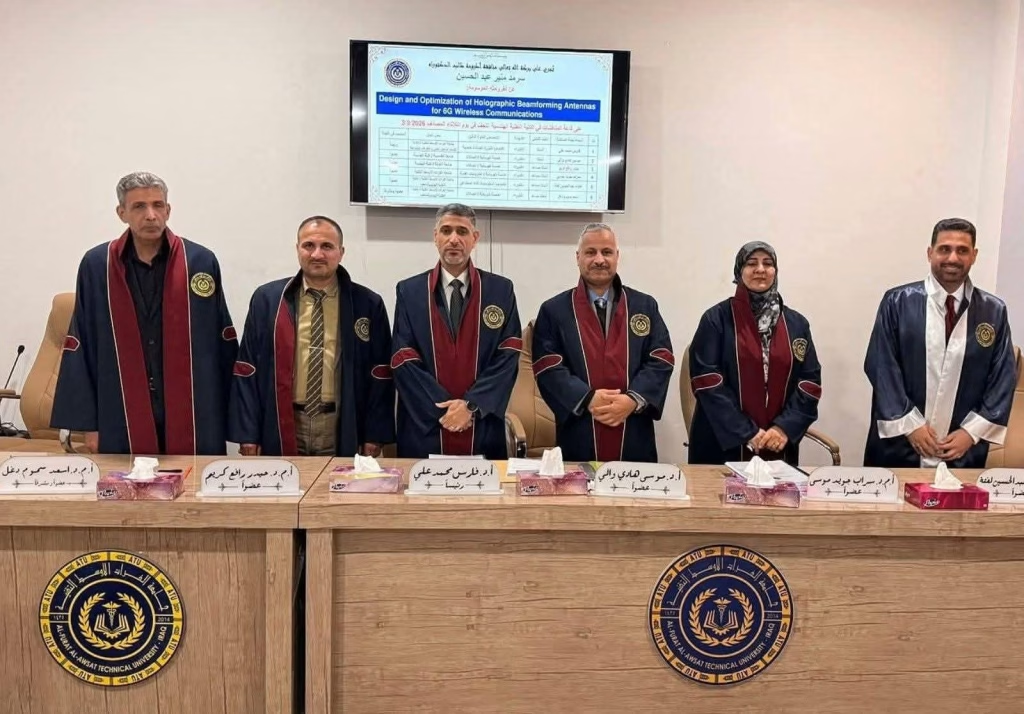

A doctoral dissertation was discussed at the Engineering Technical College of Najaf at Al-Furat Al-Awsat Technical University entitled:
“Design and Optimization of Holographic Beamforming Antennas for Sixth-Generation (6G) Wireless Communications.”
The dissertation was submitted by the researcher Sarmad Munir Abdul Hussein from the Department of Communication Engineering Technologies.
The dissertation aimed to develop a highly efficient intelligent framework for accurately and rapidly estimating the Direction of Arrival (DoA) of signals in dense holographic antenna arrays. This approach contributes to improving beamforming accuracy and enhancing the efficiency of modern wireless communication systems. The study also sought to overcome the conventional limitations of existing estimation methods—particularly their high computational complexity and their sensitivity to noise and multipath propagation—by establishing a methodology based on data-driven learning that links mathematical precision with the actual physical performance of the antenna.
The results demonstrated the superiority of the proposed deep-learning-based model, achieving very high accuracy with an average Root Mean Square Error (RMSE) of 0.00311, while maintaining a very low inference time. Moreover, the model successfully preserved the practical quality of the radiation beam, with 95% of beam-steering errors remaining within less than 0.4 degrees and with nearly negligible gain loss. These findings highlight the significant practical value of this work as a promising solution for the development of intelligent beamforming systems in sixth-generation (6G) wireless networks.