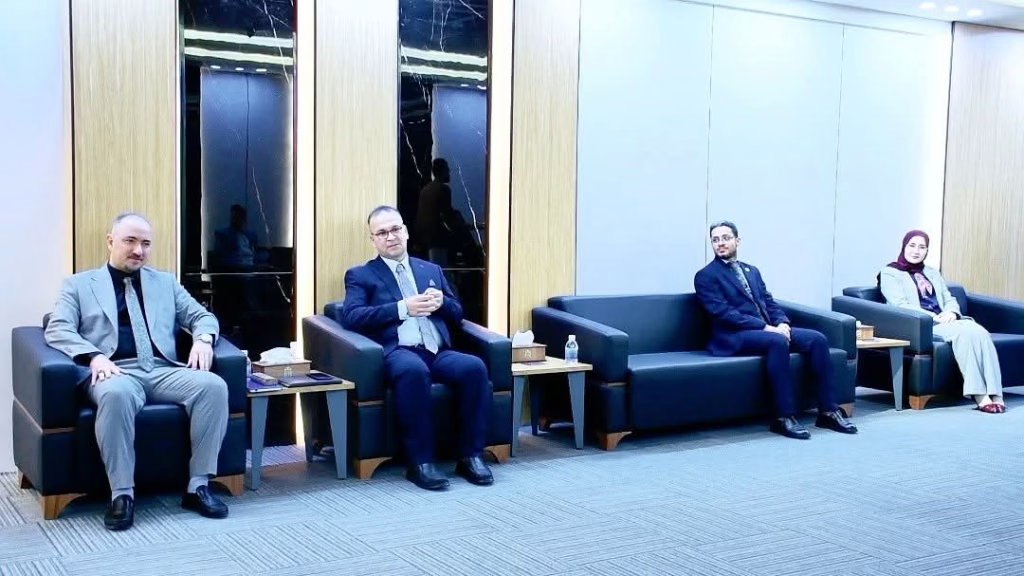

In a step that reflects its ambition to become an advanced research hub in emerging scientific fields, the Higher Institute of Nanotechnology for Postgraduate Studies at the Middle Euphrates Technical University received a specialized ministerial committee tasked with assessing the requirements for introducing doctoral programmes in its scientific disciplines.
The visit took place on Wednesday, 21 October 2026, following the direct instructions of Professor Dr. Hassan Latif Al-Zubaidi, President of the Middle Euphrates Technical University, and under the supervision of Professor Dr. Ahmed Ghanem Wadi, Assistant President of the University for Scientific Affairs.
The committee was received by Professor Dr. Bashar Jabbar Hamza, Dean of the Higher Institute of Nanotechnology for Postgraduate Studies. The ministerial committee was chaired by Assistant Professor Dr. Sinan Hussam Mahdi, Deputy Director General for Scientific Affairs at the Department of Research and Development of the Ministry of Higher Education and Scientific Research.
The committee conducted a comprehensive on-site tour of the institute’s facilities, including all scientific departments and specialized laboratories. During the visit, its members examined the advanced scientific and research equipment and the available infrastructure to assess the institute’s capabilities and determine the extent to which they meet the approved academic and scientific requirements and standards for establishing doctoral programmes.
The committee also included Assistant Professor Dr. Jasim Mohammed Mansour from the College of Science at the University of Diyala; Lecturer Dr. Ahmed Nouri Ni’ma, Director of the Postgraduate Studies Department at the Department of Research and Development; Lecturer Na’am Ali Hassan, Head of the Establishment and Admission Division within the Postgraduate Studies Department; and Ms. Asal Ahmed Bahjat, also from the same division.
This visit forms part of the formal ministerial procedures for evaluating the prerequisites for introducing new academic programmes. It also reflects the institute’s strategic commitment to developing its postgraduate education system and expanding the scope of advanced scientific research in nanoscience and nanotechnology. These efforts aim to keep pace with global scientific developments and address the needs of sustainable development and the knowledge-based labour market.